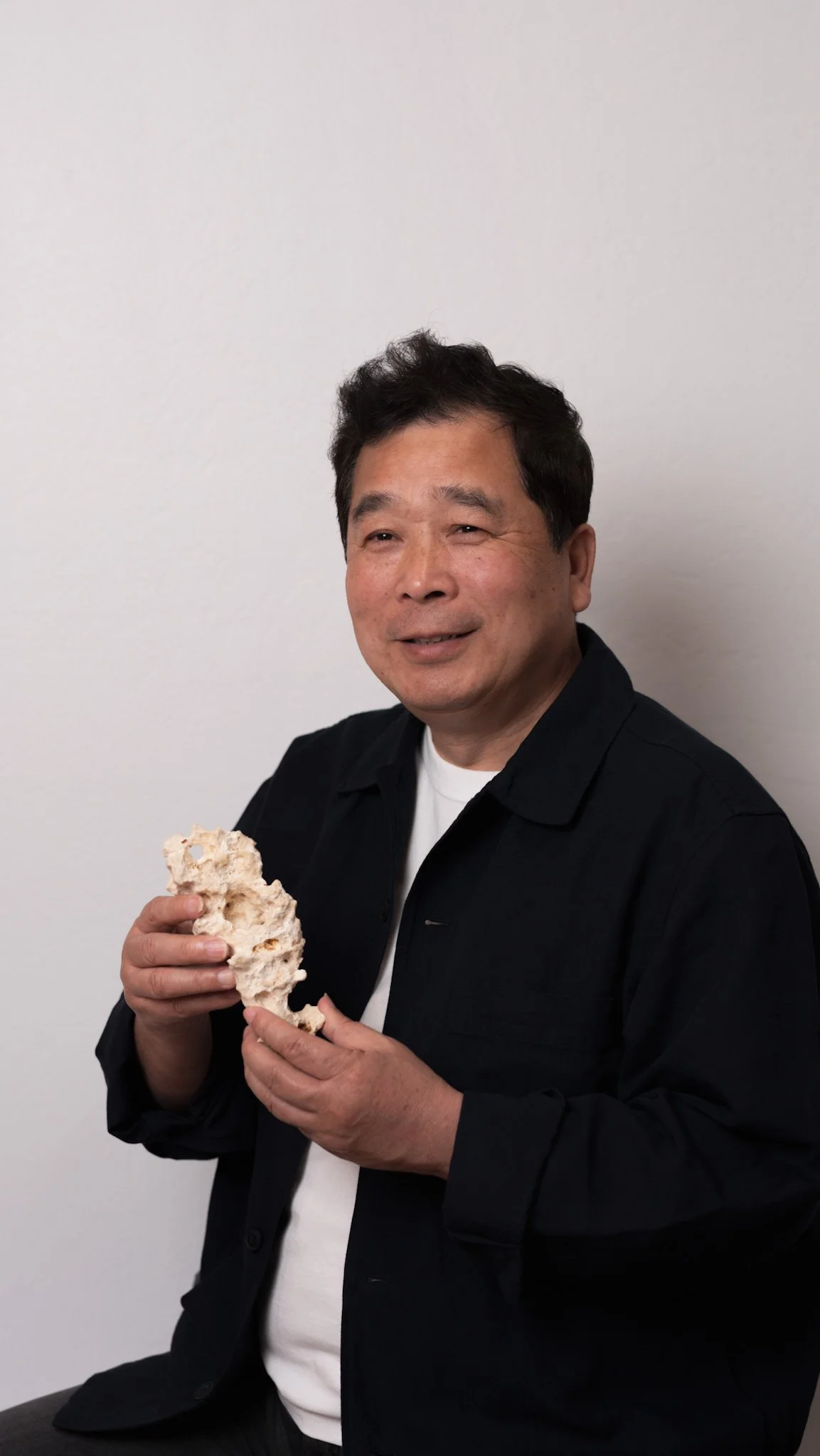
Yunming Liu
Scholar's Rock Collector · Shanshui Penjing Artist
Yunming Liu has spent forty years crossing China's most remote terrain in search of stone. Born in Shanghai, he has assembled a collection of more than three hundred contemporary Chinese stones — not the Lingbi and Taihu stones that dominate historical collections, but harder, rarer material from the country's frontiers: water-sculpted Dahua stone from Guangxi, desert-varnished stones from Inner Mongolia, and Fenglin stone from Xinjiang. These stones cannot be reshaped. They can only be found.
His medium is Shanshui Penjing (山水盆景) — the landscape in a tray. Shan (山), mountain; shui (水), water. A shallow basin stands for water; stones stand for mountains. A boundless terrain, condensed. Liu, Vice President of the Chinese Penjing Artists Association, works within this ancient form and against its conventions. Where tradition prescribes symmetrical peaks, he composes by other logic — fusing the spatial grammar of the classical Chinese garden with modern geometry, cutting and reconstructing raw geology into cliffs, valleys, and the tension between stone and void.
Lingering Snow of Wuling took eight years. The columnar peaks of Zhangjiajie have no ready equivalent in stone, so Liu gathered rare columnar Xuan stones from Anhui one by one, setting each aside until a mountain range emerged — a single dominant peak, flanked by lesser summits, grounded in his own field studies of the site.
The Long Journey, 2.4 meters in length, draws on the Song Dynasty scroll Along the River During the Qingming Festival. At its center, a carved stone figure of an old man strains to push a wheelbarrow across a bridge. For Liu, a landscape becomes complete only when it holds a human life.
Geological time, human time — met in stone, and standing still.